Webinar: Is this a man’s world?

We4DRR and the Austrian Association for Snow and Avalanches joined forces to host a webinar, featuring Andrea Mannberg from The Arctic University of Tromsø, Norway, as the invited speaker.
we4DRR Webinars
- Showcase women’s contributions to Disaster Risk Reduction (DRR)
- Support capacity building for female professionals
- Provide a platform for exchange among we4DRR members
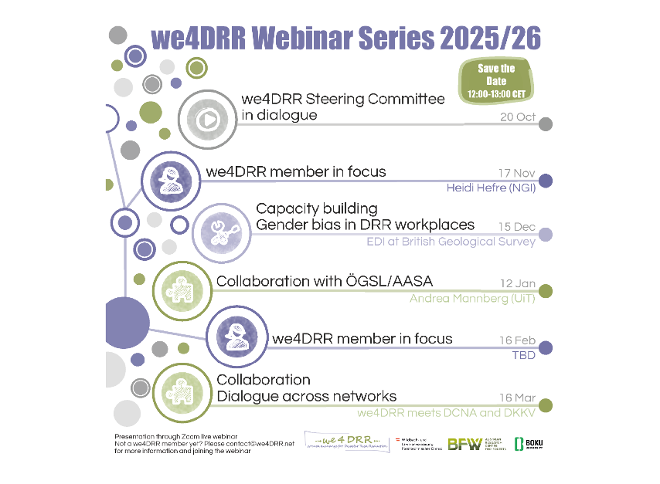
The we4DRR webinar in collaboration with the Austrian Society for Snow and Avalanches (AASA/ÖGSL) took place on 12 January 2026, featuring Andrea Mannberg, Professor in Economics at The Arctic University of Tromsø.
The session was opened by Christoph Mitterer, former president of the AASA, and Michaela Teich, Managing Director of we4DRR. Michaela Teich introduced the we4DRR network to the approximately 80 participants who joined the webinar on-site at the Department of Natural Hazards of the Austrian Research Centre for Forests (BFW) in Innsbruck and online, before welcoming Andrea Mannberg for her talk. The webinar was open to the public.
About Andrea Mannberg
Andrea Mannberg has always been interested in why people voluntarily expose themselves to risk, especially when the consequences may be fatal and the benefits of taking extra risks appear small.
Her passion for backcountry skiing brought her to Tromsø, Norway, in 2015, where she began focusing her research on risk-taking behaviour in avalanche terrain. Together with psychologist Audun Hetland, she established the research centre CARE (Centre for Avalanche Research and Education) at the Arctic University of Tromsø.
The main aims of CARE are:
- Understanding people’s decision-making in “wicked learning environments”, such as avalanche terrain
- Exploring how the quality of those decisions can be improved to reduce accidents
Webinar Talk: Is this a man’s world? Gendered experiences among professionals in the avalanche safety industry
In her talk, Andrea addressed two central questions:
- Why are women underrepresented in the avalanche safety industry?
- Is increasing gender diversity in the avalanche safety industry desirable?
Her research was based on a survey with 300 professionals from North America, Continental Europe, and Scandinavia.
The respondents described a wide range of characteristics for an ideal avalanche professional, most of which are not typically associated with traditionally male traits. The majority of survey participants also agreed that greater diversity would benefit the industry, contributing to stronger teamwork, improved performance, and a healthier workplace culture. A male-dominated organisational culture was identified as a key reason for the continued lack of gender balance in the sector. Informal networks play an important role in recruitment, and these networks are largely male-dominated. In addition, female professionals often experience their knowledge, skills, or abilities being questioned by male colleagues, which can undermine confidence and create a self-reinforcing cycle that increases the likelihood of mistakes. Women in the field are also frequently confronted with sexism.
Way forward
Andrea concluded by emphasizing that efforts should focus on improving conditions for everyone, not only for women. Leading inclusive change benefits the entire sector. She highlighted hiring practices and organisational culture as key areas where meaningful action can help increase diversity.
Q&A highlights
The discussion explored how soft skills can be identified during job interviews and highlighted positive experiences with mentoring programmes. Participants also enquired about visible improvements in diversity within the industry. In addition, the conversation addressed advice for women working in the sector, emphasizing the importance of building and maintaining professional networks.