Webinar: Gender Bias in Disaster Risk Reduction Workplaces

The we4DRR capacity‑building webinar on Gender Bias in DRR Workplaces featured insights from the British Geological Survey (BGS), focusing on gendered experiences within geoscience and organisational approaches to advancing equality.
we4DRR Webinars
- Showcase women’s contributions to Disaster Risk Reduction (DRR)
- Support capacity building for female professionals
- Provide a platform for exchange among we4DRR members
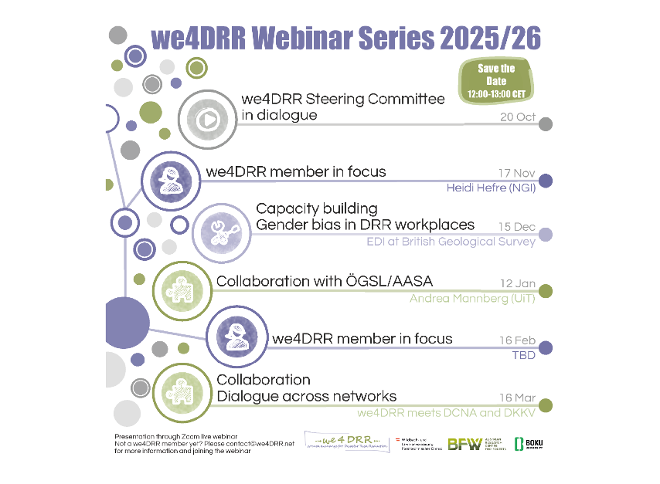
The session on 15 December 2025 was opened by we4DRR Organisation Team member Laura Saxer (Austrian Research Centre for Forests) with an overview of the webinar series and an introduction to the speakers from the British Geological Survey:
- Dr. Maria Kariuki, Equality, Diversity & Inclusion (EDI) Officer at BGS
- Dr. Keely Mills, Geoscientist and coordinator of BGS EDI and organisational‑change initiatives
Participants were welcomed to a discussion exploring gender inequality in geoscience, barriers faced by women, and the evolution of BGS’s internal practices to promote a more equitable workplace.
Geoscience and gender: context and challenges
The speakers outlined longstanding perceptions of geosciences as a masculine, physically demanding field. Studies shared during the webinar reveal that:
- Geoscience roles are commonly viewed as suitable for men, characterised by “dirty”, outdoor, hands‑on work.
- Public and student perceptions in Europe and the USA align geoscience with whiteness, masculinity, and higher social class.
- EU‑wide assessments show fields linked to geoscience (geology, engineering, laboratory science) are consistently rated as “masculine.”
Although women now enter geoscience degrees at equal or greater numbers compared to men, this does not translate into professional participation or leadership positions.
Data on gender representation
Recent data from multiple countries indicate:
- Women constitute around 30% of the geoscience workforce globally.
- Gender representation declines sharply at senior levels.
- Professional associations and geological surveys across Europe reflect persistent gaps, with women holding less than 30% of leadership roles.
Barriers identified include:
- Male‑dominated culture and everyday exclusion
- Career progression constraints linked to social expectations around caregiving
- Lack of senior role models
- Work–life balance pressures disproportionately affecting women
- Internalised pressure to “push through” structural obstacles
These barriers are interconnected and collectively affect women’s long‑term progression in the sector.
BGS gender equality journey
The speakers described how gender equity at the British Geological Survey has shifted over time. For more than a century after its founding in 1835, BGS remained almost entirely male. Women only entered geoscience roles during wartime to replace men, and they were removed when the men returned. Until the 1970s, married women were expected to leave the organisation, and it was only after the United Kingdom Equality Act (2010) that female participation began to grow.
In the last 20 years, BGS has made substantial progress, increasing the proportion of women from around 20% to nearly half of the overall workforce, though women are still underrepresented in science roles. This improvement followed deliberate actions, including joining the Athena SWAN Charter in 2013, completing an organisation‑wide assessment of barriers, implementing a five‑year gender‑equality action plan, ensuring gender‑balanced recruitment processes, and enhancing flexibility and support for staff returning from leave. These efforts led to the achievement of the Athena SWAN Silver Award.
A key milestone was the appointment of BGS’s first female Director in 2019, contributing to senior leadership now being close to gender parity. The organisation has also expanded initiatives that raise the visibility of diverse geoscience career paths and encourage wider participation.
Looking ahead, BGS aims to strengthen a positive and psychologically safe culture by addressing microaggressions, improving support for parental and long‑term leave returners, and ensuring inclusive fieldwork practices. Further priorities include enhancing career development pathways and embedding intersectionality across EDI activities. The speakers highlighted that while these efforts address gender inequality, they ultimately benefit the entire organisation.
Reflection
The session closed with an invitation for participants to reflect on their own organisational contexts through an interactive exercise. Key messages included:
- Change starts with understanding internal barriers and lived experiences.
- Structural issues require collective solutions, not individual endurance.
- Inclusive workplaces create better outcomes for everyone, contributing directly to more resilient DRR sectors.