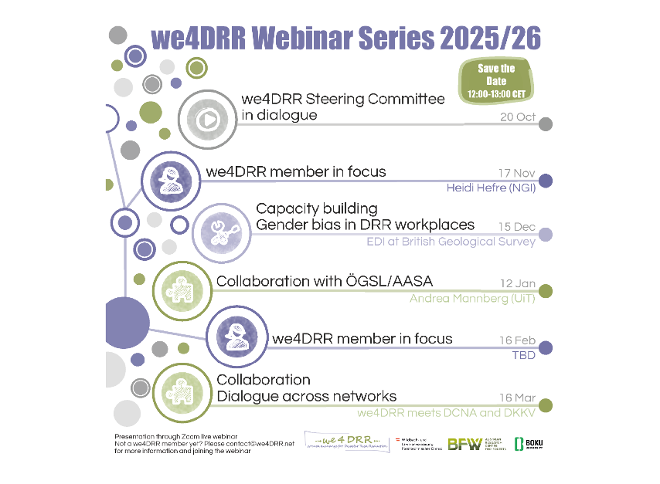
Webinar: Members in focus with Heidi Hefre

The last session of the we4DRR webinar series was focused on the member Heidi Hefre, Norwegian Geotechnical Institute (NGI), with her talk “Mountain hazard management: A journey from technical work to leading people”.
we4DRR Webinars
- Showcase women’s contributions to Disaster Risk Reduction (DRR)
- Support capacity building for female professionals
- Provide a platform for exchange among we4DRR members
The we4DRR Member in focus webinar took place on 17 November 2025, featuring Heidi Hefre from the Norwegian Geotechnical Institute (NGI).
The session was opened by Roxana Ciurean (British Geological Survey, UK), member of the we4DRR Organisation Team, who welcomed participants and introduced Heidi Hefre, Head of the Mountain Hazards Section at Norwegian Geotechnical Institute and a member of the network since early 2025.
About Heidi Hefre
Heidi Hefre holds an MSc in Geohazards and a BSc in Geology and Geophysics from the University of Oslo, complemented by studies at UNIS (Longyearbyen) and University College London (UCL). She currently leads the Mountain Hazards Section at NGI and brings over 15 years of experience in landslide risk management.
Her work focuses on:
- Advancing hazard mapping methods and translating them into practical guidelines and regulations.
- Contributing to national frameworks for risk assessment.
- Driving regulatory development to better protect communities from mountain hazards.
Webinar Talk: Mountain Hazard Management – A Journey from Technical Work to Leading People
In this talk, Heidi shared her professional journey at NGI - from hands-on hazard mapping and risk assessments to leading a team dedicated to mountain hazards. She reflected on:
- What keeps her motivated in transforming technical knowledge into practical applications and societal impact.
- The importance of collaboration and working with dedicated colleagues.
- Lessons learned in bridging the gap between science, policy, and community resilience.
Insights
After the presentation, Heidi reflected on her personal resilience, recognising that stress is inevitable but manageable when life is kept in perspective. She reminded us that family can anchor that balance, and work while important doesn’t need to be all-consuming. On leadership, Heidi challenged the old notion that the most senior expert should lead, arguing instead for leaders who listen, involve, and inspire. Reflecting on gender, she shared that her biggest early-career hurdle was age, not gender, and credited supportive colleagues for helping her thrive. Success, she concluded, is fluid - shaped by feedback, relationships, and ultimately, a life well-balanced.
Q&A highlights
The discussion ranged from technical to cultural dimensions of risk management. Heidi explained how melting permafrost could trigger rock avalanches and secondary hazards like fjord tsunamis, underscoring the need for proactive mapping and early warning systems. She also reflected on Norway’s egalitarian work culture and strong social policies, which make it easier for women to balance career and family. Questions about relocation revealed the complexity of protecting homes in high-risk zones, where funding and social acceptance remain major hurdles.
Final remarks
Closing the session, Heidi offered heartfelt advice to young professionals: don’t try to solve everything alone. Seek support, ask for help, and lean on your colleagues - because resilience in this field is built on collaboration, not isolation.